The Most Common Money-Draining Areas in Tobacco Health Science Popularization and How to Control Them
In March 2024, in a shared apartment in Yuhang, Hangzhou, I used my company card to boost a Douyin video about "Smoking and Periodontal Disease" with 800 RMB of DOU+. After 48 hours, the data looked great: 126,000 views and a completion rate of 28%. I thought I had found the traffic secret. The next day, I invested another 2,000 RMB on a similar topic. But the click-through rate dropped from 4.1% to 1.3%, and the customer acquisition cost more than tripled. Looking back, I realized: the first day's traffic included a large amount of the platform's initial exploration traffic. On the second day, the algorithm pushed the content to "general health curious users," and the proportion of people with genuine smoking cessation intentions was extremely low. That 2,800 RMB bought me a lot of likes but zero conversions.
The tobacco health science popularization track, on the surface, is about "writing articles, shooting videos, and doing science communication." But the items that really eat up the budget are often not the writing fees or editing costs. Advertising, labor, tools, and copyright — these four hidden costs are the easiest to burn through your cash flow in operations that "look professional." Below, I'll break down the pitfalls and solutions based on my actual accounting books from late 2023 to the first half of 2025, operating in both Hangzhou and Shenzhen.
I. Advertising: The Easiest Area to "Look Like It's Growing, But Actually Bleeding"
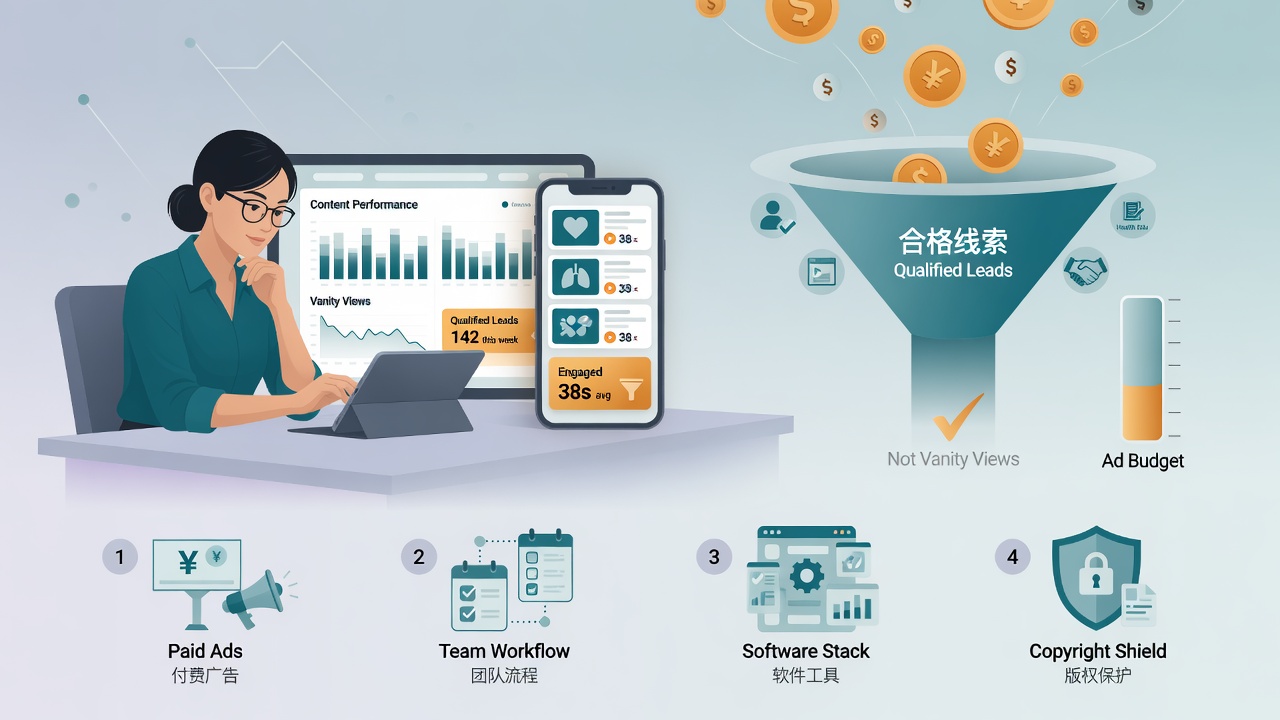
1. The "False Prosperity" of Feeds and Boosting Tools
On the short video platform side, public data shows that the CPM (cost per thousand impressions) for Douyin's information feed typically falls in the range of approximately 15–30 RMB, higher during peak hours and popular tracks. On a cost-per-click basis, a single click can cost anywhere from a few cents to several dimes. But the key isn't the price sheet — it's **whether the people you're buying are your target audience**.
In May 2024, I tried "interest targeting + automatic bidding" for two weeks in Nanshan, Shenzhen. I set a daily budget of 500 RMB with a goal of "form consultation." For the first three days, the CPA (cost per acquisition) was around 38–45 RMB, which seemed manageable. On the fourth day, the system entered "volume exploration" mode, automatically expanding the audience to people who had shown interest in "health, oral care, and wellness." Daily spending jumped to 720 RMB, and while the number of leads increased, the qualification rate dropped from about 40% to 12%. During phone follow-ups, some thought I was selling toothpaste, and others just wanted free gifts.
**Personal opinion:** The conversion funnel for tobacco-related science communication is inherently narrow — from "scrolling past" to "admitting you want to quit" to "leaving your contact info," there are more psychological barriers than in selling products. Using the e-commerce approach of "big budget to get through the learning period" easily wastes money on "health curious users" rather than "high-intent quitting users."
**Actionable solutions:**
|--------|-------------------|--------------------|
| Daily budget cap | New content and campaigns start at 100–300 RMB/day. Increase only after CPA and lead quality are stable for 3 consecutive days | Better than starting at 1000+ RMB/day and burning through budget without learning patterns |
|---|---|---|
| Stop-loss rule | If a campaign consumes 30% over budget within 48 hours with declining conversion quality, shut it down immediately — don't "wait and see" | If I had stopped at 24 hours in March 2024, I would have lost at least 1,000 RMB less |
| Content reuse discipline | Set a hard cap on how many times a piece of content can be boosted (e.g., no more than 3 times, total boost not exceeding X RMB) | Prevents "re-boosting the same content until aesthetic fatigue and CTR halves" |
Industry advice often says you need enough budget for the learning period (e.g., target CPA × a certain number of conversions), but that assumes **you have already validated the audience and content**. For the cold start phase of tobacco science communication, I believe in "losing less by testing more," not "going all in to get through the learning period."
2. The Hidden Waste of Using "Views" as a KPI
Many teams still report "800,000 views this week" in their weekly meetings. Views are cheap, but consultations are expensive — this was our consensus after comparing notes with the advertising team in Hangzhou in 2024. For the same content, the cost per consultation from organic traffic can sometimes be 1/5 to 1/3 of that from boosted traffic, because organic recommendations are more aligned with "completion + interaction" as genuine interest, while boosted traffic more easily buys "junk views where scrolling past counts as an impression."
**Solution:** Internally, keep only three money-related metrics — qualified lead cost, 7-day callback contact rate, and conversion rate from lead to in-depth consultation. Views and likes are only used for content diagnosis, not in bonus formulas. After changing the assessment for two months, our advertising budget was cut by about 35%, while qualified leads dropped by less than 10%.
II. Labor: Not "Hire Another Person," but "Process Isn't Tight"
1. The Mismatch Between Professional Endorsement and Content Production Capacity
Tobacco/smoking cessation science communication has compliance and professional requirements. Health science communication inherently emphasizes scientific knowledge as the foundation, communicated in a way the public can understand. In practice, this means: doctors/pharmacists review it once, legal scans for sensitive expressions, and the scriptwriter adapts it for spoken language. In August 2024, when we were doing the "Nicotine Dependence Self-Assessment" series in Shenzhen, a 90-second script took an average of 6.5 working days from first draft to approval. Three of those days were spent "revising wording in WeChat groups" — with the expert saying "can't be absolute," and the operations person saying "absoluteness drives completion rates," going back and forth.
How the labor cost adds up: if a part-time medical consultant charges 800 RMB per review, a full-time scriptwriter's monthly salary distributes to 200–400 RMB per piece, plus editing at 150–300 RMB, a single "doesn't look expensive" short video often costs 1,200–2,000 RMB in labor alone, not including advertising. If you produce 20 pieces in a month, that's 30,000–40,000 RMB just in labor, with at least 1/4 going to rework.
**Personal opinion:** The biggest waste isn't that the expert is expensive — it's the **lack of a "one-time clear boundary" writing standard**, causing every piece to be renegotiated from scratch.
**Solutions (after implementing these in September 2024, our rework rate dropped from about 45% to about 18%):**
- **Fixed review checklist (one page)**: No absolute efficacy claims, no unlabeled "cure/special effect," tobacco hazard data must cite source type (guideline/review/official statistics), comparisons of e-cigarettes/traditional cigarettes must state "cannot be understood as harmless."
- **Weekly topic meetings capped at 40 minutes**: Fixed on Mondays, only set 5 outlines + data points + compliance risk points, don't write full text on the spot.
- **Expert time purchased by "batch"**: Every Wednesday afternoon, 2 hours for intensively reviewing 8–10 pieces, no scattered interjections; overtime topics go to next week. Changed from "per piece" to "per session" pricing, reducing per-unit cost by about 30%.
- **Templated structure**: Opening conflict scene 8s → Mechanism 20s → One actionable step → Disclaimer voiceover. After unifying the structure, editing follows templates, and efficiency roughly doubled.
2. The "Versatile Operator" Illusion
Having one person write scripts, edit videos, run DOU+, and reply to DMs saves one HC for the first two months, but quality starts to decline in the third month: ad campaigns go unattended, high-intent users in comments wait 12 hours for a reply. In January 2025, during my Hangzhou project, I calculated: the leads lost due to slow responses, valued at the qualified lead value at that time, amounted to more than half a month's salary for a junior operator in latent losses.
**Solution:** Even when you're short-staffed, split roles across the daily schedule — production in the morning, ad review and DM replies in the afternoon. If daily ad spend exceeds 300 RMB, someone must monitor the backend; no autopilot.
III. Tools: Subscriptions Aren't Expensive, But the "Stack" Is
1. Tool Sprawl Syndrome
By the end of 2023, our tool list included: editing membership, subtitle tool, cover design, pseudo-original rewriting, data dashboard, cloud storage, meeting tools, forms... None were expensive individually, but the total monthly cost reached 1,200–1,800 RMB. The switching costs were even higher: assets in Tool A, subtitles in Tool B, data in Tool C, with someone spending half a day each week "finding files, exporting tables, and having mismatched numbers."
**Personal opinion:** The true cost of a tool = subscription fee + learning cost + decision latency caused by data silos. The third item is often the largest.
**Solutions:**
- **Quarterly tool audit**: Who uses it? How many times last week? Is there a free/existing account alternative? If usage count is zero for two consecutive weeks, cancel next month. In Q4 2024, we cut 4 subscriptions at once, saving about 600 RMB per month with no perceptible drop in output.
- **One "content hub" principle**: Final videos, scripts, data sheets, compliance annotations all go into the same directory structure (by "year/month/topic"), prohibited from existing only in someone's WeChat.
- **AI assistance limited to specific scenarios**: OK for "outline expansion, colloquial rewriting, comment classification"; absolutely NOT OK for "fabricating smoking hazard data, faking research conclusions" — rework and reputation risks far outweigh the hour saved. In healthcare content production, the industry also emphasizes that tools must embed compliance and copyright awareness, otherwise the higher the efficiency, the faster the crash.
2. Data Tools Bought But Not Used
Spending 200–400 RMB/month on a dashboard, but still relying on screenshots in weekly meetings. My advice: cancel these directly, and switch to "filling in 8 mandatory fields 72 hours after each post": impressions, completion rate, interaction, homepage visits, DMs, leads, cost, notes. Excel is sufficient until daily spending reaches tens of thousands.
IV. Copyright and Assets: One Dispute Can Cost Half a Year's Advertising Budget
1. The "I Thought I Could Use It" Trap with Images, Music, and Literature
In June 2024, a video about "Secondhand Smoke and Children's Respiratory Health" used a stock-style image for the cover without purchasing commercial rights. The platform reported and took it down, and the remaining boosted balance became entangled. Redoing the cover, resubmitting for review, and obtaining supplementary material authorization didn't cost much directly, but the schedule lost 5 days, and that week's lead target was missed.
Literature citations are also easy to cross the line: using screenshot abstracts as an "evidence wall" filling the screen may involve improper use; worse, during secondary distribution, it could be twisted into "a certain paper proving a product is effective" — extremely dangerous in tobacco/smoking cessation content.
Doctors or professionals doing science communication also face platform rules and expression boundary issues: it's not "as long as you state science, you're fine," but rather **the mode of dissemination, absolute language, and product implications** all carry compliance and legal risks. Health science communication has official principles of "scientific, understandable, and participatory," which in practice means: you need to be professional enough, but also not write it as a soft ad.
**Solutions:**
- **Asset whitelist**: Only use image/audio libraries with purchased commercial licenses; background music fixed to 3 licensed tracks, prohibiting editors from randomly searching for "free" ones on the fly.
- **Literature cited, not copied**: State the conclusion orally + display "source type and year" on screen. For detailed citations, put them in the description or a long-form graphic post, and keep the draft.
- **Real patients and cases**: Real patient stories require written authorization; using "fictional composite cases + labeling" is safer than unauthorized filming or unlicensed medical records.
- **Product-related red lines**: If a science communication account also promotes smoking cessation products, separate "health facts" from "product information" at the script stage to avoid being deemed as exaggerated advertising. Don't gamble on compliance paths by "posting and then deleting."
A serious copyright/compliance incident often costs more in PR and suspension losses than a full year of legitimate asset subscriptions. This expense should be treated with an "insurance" mindset, not a "save where you can" one.
V. A "Burn Priority" Checklist You Can Pin on the Wall
Listed by priority after my own experience (the earlier, the more urgent):
- **Advertising without audience validation**: First use organic traffic or minimal budget to validate "who will DM/leave contact info," then scale up.
- **Define qualified leads**: Without a definition, there's no cost control. Our definition: confirmed smoking cessation intention within 48 hours of adding WeChat + not a competitor/student doing homework + can generally state their smoking history.
- **Review and production SOP**: Reducing rework makes more money than cutting expert rates.
- **Tool and subscription diet**: Quarterly audit.
- **Copyright and expression red lines**: Whitelist + prohibited terms + source attribution.
**Budget allocation experience values (monthly budget example, scalable):**
- Advertising testing: 40% (of which 70% for validated content, 30% for new tests)
- Labor (including part-time review): 35%
- Legitimate assets and essential tools: 10%
- Contingency and accident reserve: 15% (re-shooting after takedown, emergency rush reviews, complaint handling)
Many teams set contingency at 0. When something goes wrong, they dig into next month's advertising budget, creating a "panic-spend-lose-more" cycle.
VI. Three Sentences I Truly Believe
**First, the money in tobacco health science communication should be spent on "credibility" first, not on "being louder."**
Scare-tactic headlines look good in short-term CPM, but over time they turn your account into a "sensational health channel" that users don't trust for quitting advice. Once trust is broken, subsequent advertising is just paying for other people's perceptions.
**Second, advertising without a definition of "qualified lead" is just a donation.**
The 2,800 RMB in Hangzhou in March 2024 taught me this: views can fabricate prosperity, but conversations over the phone cannot be fabricated.
**Third, cost control isn't about making everyone work overtime or downgrading tools to just the free version of CapCut — it's about reducing ineffective actions.**
Ineffective boosting, ineffective meetings, ineffective rework, ineffective subscriptions — if any two of these exist simultaneously, even a monthly budget of 10,000 RMB won't hold up.
If you want to start now, don't plan for the full year. Just do four things this week:
- ① Write 3 criteria for "qualified leads";
- ② Add a 48-hour stop-loss line for active campaigns;
- ③ Make a tool list and mark the "can-cut" ones;
- ④ Post the prohibited terms and asset whitelist into the scriptwriters' group announcement.
After doing these four things, you'll know for the first time: is the money really being spent on growth, or on chaos?